CALL FOR PROPOSALS!
The Revolutionary Papers Project in conversation with Pluto Press seeks contributions for an edited publication entitled 'African Revolutionary Papers: Politics and Practices of Activist Archiving'
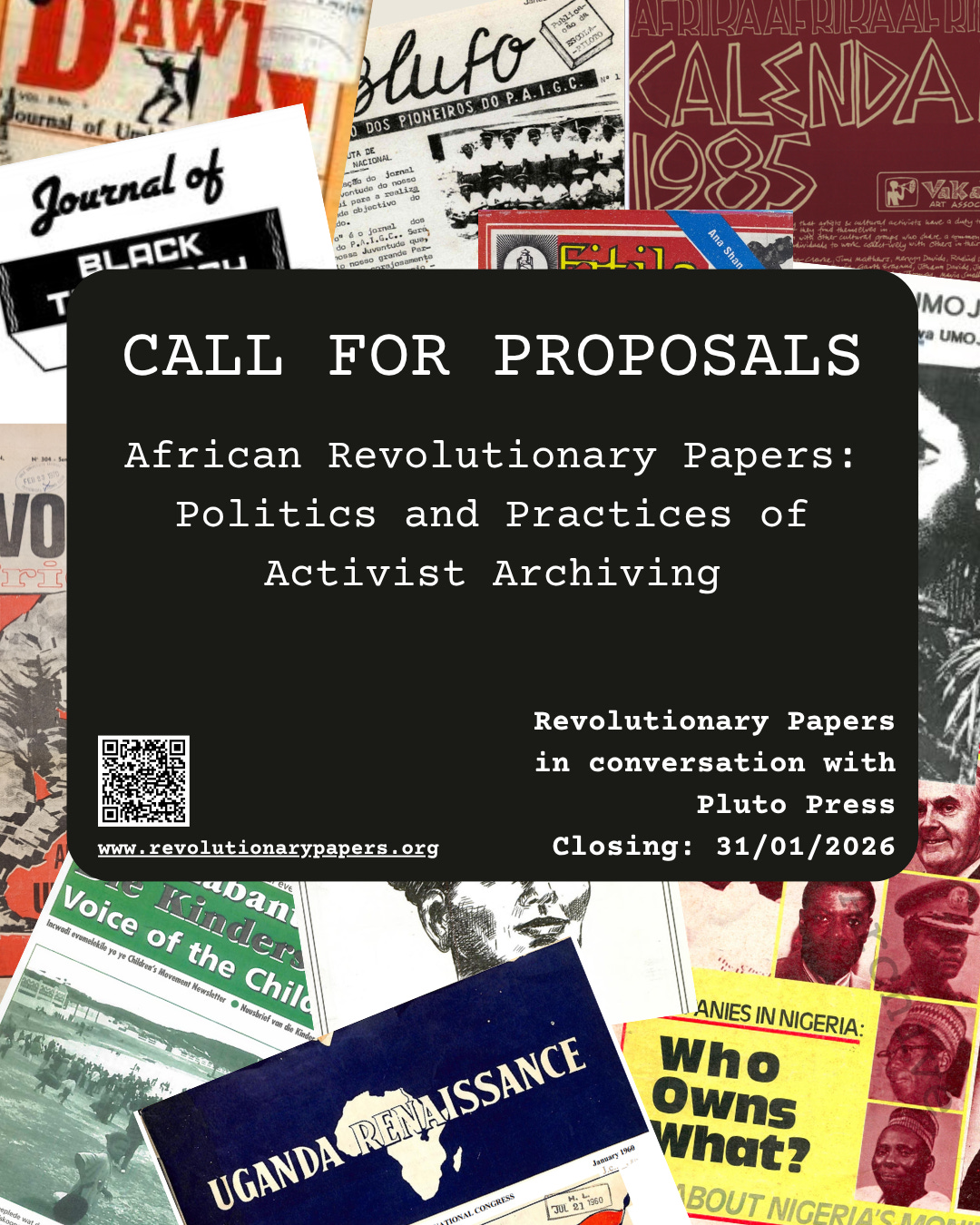
Africa has a rich and varied history of emancipatory movements, from the mass anti-colonial movements that swept across the continent from the early 20th century, which culminated in the defeat of colonial rule, to the pro-democracy campaigns against authoritarian post-colonial regimes and the waves of youth protests in the recent past. These radical movements have involved an array of social groups, including peasants, workers, women and men, students and youth, the unemployed and middle classes. They established numerous movements and organisations to execute struggles for freedom: nationalist movements, trade unions, women’s collectives, student organisations, peasant associations, liberation armies and left parties, among others. In their different contexts and time, these movements generated radical ideas and praxes that defined their modes of organising and repertoires of struggle. Central to many of them was the production of publications that were pivotal in the articulation and propagation of their politics (that is, their ideology, programmes, strategies) and as tools of organising and mobilising. These movement produced publications are important archives of emancipatory politics, especially of the past and ongoing anticolonial struggles for realising liberation on the continent. They contain histories of these movements, their activists, struggles, political debates and analyses.
While publishing and publications in Africa have received considerable scholarly attention, the histories of radical, left papers have until recently remained largely obscured. The Revolutionary Papers project aims to contribute to a greater awareness and renewed interest in radical publications in the global South. Revolutionary Papers looks at the way that periodicals (including newspapers, magazines, cultural journals, and newsletters) played a key role in establishing new counter publics, social and cultural movements, institutions, political vocabularies and art practices. Operating as forums for critique and debate under conditions of intense repression, periodicals facilitated processes of decolonization during colonialism and after the formal end of empire, into the neocolonial era. Revolutionary Papers traces the ways that periodicals supported social, political and cultural reconstruction amidst colonial destruction, building alternative networks that circulated new political ideas and dared to imagine worlds after empire.
The Revolutionary Papers project has illuminated how newspapers, journals, magazines, and newsletters across the global south served as vital forums for anticolonial critique, collective thought, and political imagination under conditions of colonial and authoritarian repression. These publications not only circulated ideas and fostered networks of resistance but also acted as archives of emancipatory struggle- spaces where political vocabularies, networks of solidarity, political analysis, cultural movements, and artistic practices were forged in conversation and conflict.
Yet, the histories of papers produced by Africa’s left and radical movements remain unevenly accessed and understood. Further work is needed to find, study and activate these activist archives, which document the continent’s ongoing anticolonial struggles, revolutionary visions, and experiments in freedom, thereby reshaping how we understand Africa’s intellectual and political histories.
Following the success of the special edition of the Radical History Review on Revolutionary Papers and the publication of a series on the same theme in Africa Is A Country, we are now issuing a call for abstracts on papers of the African left for publication in an edited book that features both:
I. contributions that highlight the way African revolutionary papers played key roles in establishing new counter publics, social and cultural movements, alternative organizations, education, political vocabularies, art practices, and anticolonial imaginaries.
II. contributions that delve into the politics and practices of archiving activist publications from both the past and present.
In this edited book project we focus on papers of the African left, featuring movement journals, widening our appreciation for the range of self-publication that came out of oppositional movements across the continent across time, and opening up the question of the role of archiving in movement building and movement histories.
We seek contributions that critically examine the politics, practices, and ethics of archiving African revolutionary and anticolonial materials. Archiving here is understood not merely as preservation, but as an active, contested process- one bound up with the making and remaking of movements, memories, and futures. Where do these materials reside, and who holds, cares for, and activates them? What are in these materials, why were they important in the past, and why are they important now? What forms did movement libraries, documentation centres, and educational spaces take amid anticolonial and ongoing struggle, and how did they shape the circulation of revolutionary thought? We seek reflections on the fragility and fragmentation of radical archives, often scattered, decaying, and incomplete, as well as on the risks of fetishising both the materials and the archive itself. Contributors are encouraged to explore the relationship between organising and archiving; the uneven politics of access, preservation, restitution, and repatriation; and the possibilities of “living archives” and education initiatives that sustain anticolonial memory as a collective practice relevant to ongoing struggle.
We recognise that radicalism is contextual and that revolutionary periodicals and movement materials manifested in vastly different forms- from Communist party organs, to guerilla newsletters and bi-lingual internationalist literary magazines. Researchers are invited to select and present on one or more collections of prints from any genre they consider relevant.
In line with our ongoing commitments to anticolonial and antiauthoritarian praxis today, through our scholarship and political engagements, we also ask all contributors to reflect on the contemporary political significance of revisiting these periodicals and archival practices in our current moment.
While the collection will predominantly focus on African left papers and archival projects from across the continent, we are also open to contributions from and about the African diaspora, especially solidarity movements and their archiving.
Contribution Formats:
The book will be divided into three sections, each with a unique form:
African Revolutionary Papers
This section will feature 1000-1200-word length submissions engaging specific periodicals and other print ephemera – including newspapers, cultural and literary journals, magazines, manifestoes, newsletters and political pamphlets – as key sites of Left, anti-imperial, anti-colonial, anti-authoritarian, anti-sexist critical production from across the African left. It will follow the format and include some of the pieces published in the Revolutionary Papers Africa is a Country series.
Interviews with Revolutionary Archivists
This section will feature select 3000-word length interviews with archivists or archival projects.
Essays on the Politics and Practices of African anticolonial/activist archiving.
This section will feature 7000-word length well researched original articles that critically examine the politics, practices, and ethics of archiving African revolutionary and anticolonial materials, as described above. These essays will be peer reviewed. Each will have 1-2 pages of illustration.
Publication Workshop and Process:
A wider aim of this initiative is to contribute towards building a network of researchers, scholars, archivists, artists, and activists committed to African revolutionary pasts and present, and in processes of activist archiving as constituent of building African left movement histories and futures. We will therefore aim to convene all contributors to forge links across ongoing projects. Support will be provided for contributors to come together for an in-person workshop to present midway through the publication process.
Schedule:
31 January 2026: Abstracts due
23 February 2026: Notification of successful applications
1 June 2026: Draft 1 due
1 October 2026: Draft 2 due for circulation to all authors in preparation for the workshop
November 2026: International Workshop
15 December 2026: Final drafts due
2027: Book publication date
Submission guidelines:
Please submit a title and abstract (of 500 words max) for your proposed submission. Please indicate which of the three formats you are proposing, the movements, materials moments, and questions you are focusing on, and how you will be bringing it into conversation with current political struggles.
For submissions focused on particular African revolutionary papers, in addition to your own focus, we ask that abstracts also include a description of the periodical(s) upon which the submission is based, including where relevant a. Title(s), b. Circulation period(s) and region(s), c. Publication language(s), d. Type(s) (e.g. was it a weekly magazine or ad hoc guerilla bulletin), e. Name of the editorial collective(s) or movement(s) responsible for publication (if applicable), f. Digital copy of periodical cover (if available).
For submissions that focus on particular archives or arching initiatives or practices, in addition to your own focus, please include an overview of the materials that constitute the archives/archival practices you are discussing, and an image if possible of the archive or from the project.
Please also include a short bio (max 250 words).
Submissions should be sent to: africanrevolutionarypapers@gmail.com by 31 January 2026